When the internet drops out, the official explanation isn’t always the real one. A Monash-built platform delivering independent, real-time evidence has been named among Monash University’s Top 10 Discoveries and Impacts of 2025.
The internet is the most powerful communication system of our time, essential to everything from financial markets to political participation.
Yet it is also inherently fragile.
During natural disasters, cyber-attacks, authoritarian suppression and conflict, entire populations can lose connectivity in an instant. A Monash University research platform is capturing these incidents in near-real time.
The Monash IP Observatory tracks disruptions, delivering consistent, independent data on the availability and quality of internet connectivity at a global scale.
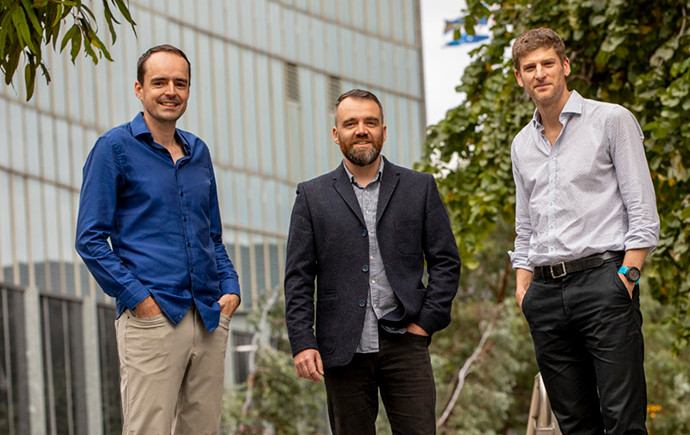
Developed in Monash University’s SoDa Labs by Associate Professor Klaus Ackermann, Professor Paul Raschky and Professor Simon Angus (L-R main image), the cloud-based platform monitors thousands of regions worldwide, pinpointing outages as they unfold.
Now, the Observatory has been recognised as one of Monash University’s Top 10 Discoveries and Impacts of 2025.
“Having the Observatory recognised, alongside teams literally contributing to solutions to several major planetary challenges, is incredible,” Professor Angus said.
“It’s a significant marker of respect and support from our peers for what we’ve built and what we’re doing through the Observatory.”
Seeing potential: How the Observatory was born
The Observatory grew out of a shared curiosity among the trio, exchanging notes on unusual, underexplored data sources.
The catalyst was when Prof Raschky came across an anonymous website that visualised the results of hundreds of thousands of computers scanning for other online devices worldwide.
“In a 24-hour period in their data, you could clearly see the way humanity was connecting and disconnecting from the internet, in harmony with the sleep-wake cycle,” Prof Angus said.
They instantly saw the potential.
“But, we also realised we needed to control the science of it – the sampling and measurement – ourselves,” he said. “And, of course, to do it responsibly.”
In 2017, the team set to work building their own observational platform. They applied the new system for a few weeks at a time to Turkey during the constitutional referendum, Hurricane Irma and the Russian Presidential elections, before realising event-by-event monitoring was not enough.
“To truly identify an anomaly, you need a really good baseline. This requires continuous measurement,” he said.
“So, in early February 2019, I ‘turned on’ the Observatory at global-scale for good. We’ve been monitoring continuously, 24/7, the world over, ever since.”
‘Not the full story’: From measurement to accountability
What began as a measurement system has evolved into a tool with huge human rights applications in conflict zones and politically sensitive environments, where access to verified information is often limited.
“In those contexts, people are sometimes told outages are caused by weather events or technical failures, when that may not be the full story,” Prof Angus said.
“We can identify where connectivity has gone offline in real time, which can be critical in conflict zones or during natural disasters.”
Since 2020, the Observatory’s underlying technology has supported the United Nations Office of the High Commissioner for Human Rights, providing daily global anomaly data to help identify potential disruptions and emerging risks.
It has also supported reporting and analysis by international media organisations, including Reuters, The Washington Post, The Economist, Wired and the ABC, as well as informing humanitarian organisations and international legal teams responding to events.
“Because we can see internet disruptions within minutes of them occurring, it provides a very different view of what is happening on the ground compared to traditional reporting systems,” he said.
“The value of the Observatory is that it allows us to independently document when and where connectivity is disrupted, validating eye-witness accounts.”
‘Adventurous research’: The importance of independence
Professor Angus said the decision to base the Observatory at Monash was deliberate. “Universities carry a level of trust that is increasingly rare,” he said.
That credibility is reinforced not just by academic rigour, but by financial independence.
“A common misconception is that observatories like this should be provided by commercial players, or in the not-for-profit space,” he said.
“More observatories are better than less, and we welcome all solid measurement initiatives, but academic custodianship confers a particularly high level of independence and trust on our findings. This is precious.”
The Monash IP Observatory has largely been sustained through ongoing support within the Business and Economics Faculty.
That has allowed the Observatory to grow into something far beyond its original scope.
“One of the real strengths of Monash is that there is space to back ideas that don’t look conventional at first glance,” he said.
“In Monash Business School, we have some of the best opportunities through internal seed funding to promote adventurous research,” he said.
“The Observatory is an example of what can happen when research is allowed to evolve, rather than being forced into a narrow definition from the outset.”
Seven years on, the evolution continues.
“We’d love to be able to grow our team to have someone dedicated to translating our measurements into analysis pieces every week,” he said.
“There’s a lot happening in the internet layer, and we are vastly under-utilising our data at this stage.”
Discover more about the Monash IP Observatory.